By Andrew Lord
5 November 2022
As the Qatar World Cup approaches, Germany once again finds itself struggling to find a tried and tested centre forward. The issue has been exacerbated by the news that Timo Werner will miss the World Cup after tearing the syndesmosis ligament in his left ankle during RB Leipzig’s 4-0 victory over Shakhtar Donetsk in the Champions League on Wednesday evening.
The extent of the problem is further illustrated by the recall of Mario Götze, a false nine, to the provisional World Cup squad, but the pressure will now be on Flick to nominate an out-and-out striker, with Werder Bremen forward Niclas Füllkrug and VfL Wolfsburg striker Lukas Nmecha the most likely options.
Three strikers, 21 caps, one goal
One major stumbling block is that 29-year-old Füllkrug has yet to represent Germany at full international level. His international experience is limited to U18, U19 and U20 level. Last season, he scored 19 goals in 33 league games as Werder Bremen returned to the Bundesliga, finishing second in the table behind Schalke 04.
Nevertheless, Flick has spoken in favour of Füllkrug’s ability: “We know that Niclas possesses the skill set which could enhance our game. A big, athletic penalty-box striker would add flexibility to our attacking game.”
However, 2014 World Cup winner Sami Khedira is sceptical about a World Cup call-up for the Bremen striker: “I think players need to have performed at a certain level over a long period of time in order to make a World Cup squad. Füllkrug has been playing in the Bundesliga for three months, but he is yet to prove himself at international level. He’s a really good Bundesliga striker, but can he assert himself against top nations? Perhaps he can, but he has to prove himself. I think it would be an experiment, so I’m gravitating towards a no.”
Lukas Nmecha is also something of an unknown quantity with just seven full international appearances and no goals. The 23-year-old represented England at all levels from U16 to U21, before switching to Germany at U21 level where he has scored 12 goals in 20 appearances. He was top scorer at the 2021 UEFA European Under-21 Championships and in the final he scored the winner in the 1-0 victory over Portugal.
The dilemma facing Flick is illustrated by the fact that this season, only two players in the top ten Bundesliga scorers are eligible to play for Germany: Füllkrug, who has scored nine goals including three penalties, and attacking midfielder Jamal Musiala of Bayern Munich.
Since Germany were beaten 2-0 by England at Wembley Stadium in the Round of 16 at the delayed 2020 European Championships, the nation has played seven World Cup qualifiers, two friendlies and six Nations League fixtures, providing ample opportunity to experiment with a target man. Now Flick has just one friendly against Oman on November 16 before the opening World Cup fixture against Japan on November 23.
When you think of German forwards a number of players come to mind: Uwe Seeler, Gerd Müller, Karl-Heinz Rummenigge, Jürgen Klinsmann, Rudi Völler and Miroslav Klose. ZDF sports reporter Manu Thiele has described these strikers as being part of the “DNA of German football.” But the lack of strength in this position is not a recent phenomenon. At the 2018 World Cup in Russia, German trainer Joachim Löw’s preferred formation saw Timo Werner play the centre forward role, with the 33-year-old Mario Gómez on the bench. With Germany needing a victory in the final group game against South Korea in Kazan, Löw resorted to throwing centre back Mats Hummels forward as German crosses rained in on the Korean goal.
A potential wildcard
The loss of Werner through injury has led to the emergence of a potential wildcard – ex-Hoffenheim and Leverkusen striker Kevin Volland. However, the 30-year-old forward, who now plays for AS Monaco in Ligue 1, has played just 15 games at international level, with one goal in an 8–0 victory over San Marino back in 2016. Volland was included in Germany’s 26-man squad for Euro 2020, but he was given just two minutes of game time, coming off the bench to replace Robin Gosens in the 1-0 defeat to France. But he is on form, with four goals so far this season, including a hattrick in Monaco’s 4-1 victory over Red Star Belgrade in the Europa League.
There is a precedent for a German forward in his late 20s to make an impact at a major tournament. Oliver Bierhoff was 28 when he made his debut for Germany in 1996. He was included in Berti Vogts’ squad for Euro 96 and came off the bench with Germany losing 1-0 in the Euro 1996 final against Czech Republic, scoring two goals to win the tournament.
The domination of Robert Lewandowski was such that before signing for Barcelona in the summer he topped the scoring charts in seven of his nine years in the Bundesliga. The last German to top the scoring charts was Eintracht Frankfurt’s Alexander Meier in 2015.
Many of the issues afflicting the German national side were hidden due to the success of Miroslav Klose, who scored 71 goals in 137 international appearances, making him Germany’s all-time record goalscorer. He was strong in the air and was lethal in the same way as Gerd Müller, but another aspect to his game was his ability to come deep. Klose won the FIFA World Cup Golden Shoe in 2006 and his 16-goal haul made him the FIFA World Cup all-time record goalscorer.
Tiki-taka and false nines
Spain dominated world football with tiki-taka Euro Championships in 2008 and 2012 and the World Cup in 2010. Therefore, it seems apt that Jogi Löw’s triumph in the 2014 World Cup was sealed by Götze – Germany’s false nine.
While traditional number nines never really went away, they are experiencing a renaissance in world football with target men much sought-after commodities. Pep Guardiola signed Erling Haaland, a classic centre forward, in the summer for £51.2m and is reaping the rewards. The 21-year-old has scored 17 goals in 11 Premier League fixtures so far this season. The goalscoring exploits of Robert Lewandowski, Harry Kane, Karim Benzema and Álvaro Morata provide further evidence of a return to prominence for target men. Benzema recently won the Ballon d’Or, breaking the domination of two false nines, Lionel Messi and Cristiano Ronaldo, who since 2008 have won the award every year apart from 2018 when Luka Modrić won it.
The lack of German strikers has been highlighted by two world class managers. Arsene Wenger commented: “Germany used to have world class strikers at every club. You’ve gone wrong somewhere. Currently there aren’t enough strikers in Germany.” While Klopp said: “England has at least seven classic centre forwards who could play for the national team. Why don’t we?”
Now, with under a week until the final 26-squad is to be submitted to FIFA, Flick will be forced to take a punt on Füllkrug, Nmecha or the wildcard Volland.
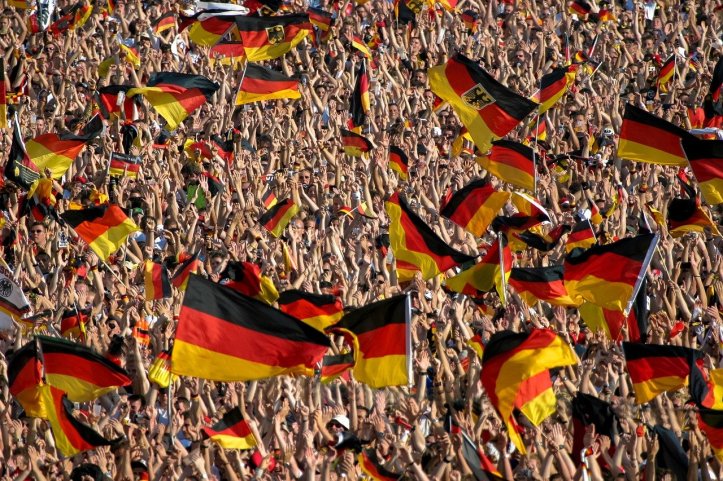
In Group E, Germany will face Japan, Spain and Costa Rica.
© Andrew Lord 2022
 German Football