By Andrew Lord
21 July 2022
Germany and Hamburg legend Uwe Seeler has died at the age of 85.
He represented West Germany at four World Cups and was captain in the World Cup final against England in 1966. Four years later he was part of the West Germany team that finished in third place in the 1970 World Cup in Mexico. He scored 43 goals in 72 international games, but he was never able to realise his dream of winning the world cup: “While I was at four World Cups, I’d have liked to have won the title once. I didn’t have the luck,” Seeler said.
Seeler was a one-club man, playing for Hamburg from 1954 to 1972. He won the Bundesliga title with Hamburg in 1960 and the German cup in 1963. He scored 404 goals in 476 games and was voted Bundesliga Player of the Year in 1960, 1964 and 1970.
In 1961, Hamburg lost to Barcelona on the away goals rule in the semi-final of the European Cup and in the 1968 European Cup Winners’ Cup Final, Hamburg lost 2-0 against AC Milan.
Our Uwe
He was a highly popular player in Germany, known affectionately as “Uns Uwe” (our Uwe). He was known for being down-to-earth and was only sent-off once in his entire career. In the summer of 1961, he rejected a lucrative move to Inter Milan, which would have earned him one million marks, preferring to stay at Hamburg.
Seeler was known for his prowess in the air despite his stature, he measured 1.70 m, and famously scored a remarkable headed goal against Peter Bonetti in the quarter-final of the 1970 World Cup in Mexico as Germany fought back from a two goal deficit to beat England 3-2.
In his obituary in the Guardian, Brain Glanville quoted former Northern Ireland and Burnley forward Jimmy McIlroy, who once said: “If there was a brick wall there and the ball was on the other side, then Uwe Seeler would go right through it.”
Bundesliga clubs also paid tribute to the West German great. Bayern Munich CEO Oliver Kahn said: “When you think of German football and its greatest players, you think of Uwe Seeler. His death is a painful loss for the entire football family.”
Hans-Joachim Watzke, CEO of Borussia Dortmund, said: “Uwe Seeler was an extraordinary footballer, but above all an extraordinary person. Without a doubt, he was one of the best strikers that Germany has ever produced. Uwe Seeler was a man with deep roots in his hometown of Hamburg.”
UEFA released a statement saying: “A veteran of four World Cups, he played more than 70 times for his country and helped shape modern German football. Rest in peace, Uwe.”
A sporting family
Seeler was born on 5 November 1936 in Hamburg-Eppendorf and came from a sporting family. His father Erwin was a dock worker and a footballer for SC Victoria in 1932 and Hamburg in 1938, while his mother was a talented swimmer and handball player.
As was the case for many of his generation, Seeler learned to play football on the streets with his brother Dieter. He joined the Hamburg youth team in 1946 and made his debut for the first team in August 1953.
In February 1965, an Achilles tendon injury threatened to derail his career. He was out of action for a year following an operation, but Seeler fought back.
In 1972, 70,000 fans came to the Volksparkstadion to see Seeler play his final game for Hamburg against a World Eleven.
Seeler was elected President of Hamburg football club in 1995 and once said: “I made two big mistakes in my life: building a swimming pool and becoming HSV president.” After a series of scandals involving board members, he resigned in 1998.
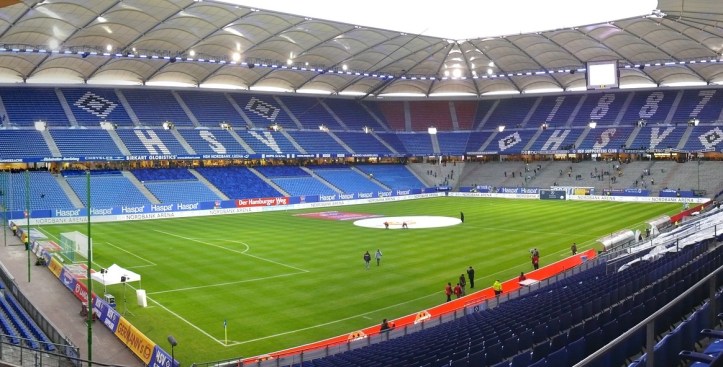
In summer 2000, the renovation of the Volksparkstadion into a modern stadium was completed. Many fans wanted the ground to be renamed the “Uwe-Seeler-Stadion”, but instead the naming rights were sold to AOL for over €15.3 million.
In 2016, he told German football magazine Kicker why he had never become a trainer: “I wouldn’t have been a good trainer. I demand too much. I was angry enough when I played badly. I’m a quiet person, but on the pitch I was different.”
Rejecting European giants
Of the attempt by Inter Milan to persuade him to sign for them, he said: “The suitcase of money was so heavy I couldn’t lift it. The Italians really tried to convince me over three days. But I turned them down. Nobody could understand why and my teammates told me I was mad. I made a conscious decision to choose Hamburg and Germany, and my job with Adidas and my family played a major role. The millions from Italy didn’t appeal to me. I’m just not that sort of person.” Seeler also received, and rejected, written offers from Real Madrid and Barcelona.
When asked if the famous Wembley goal in the 1966 World Cup final had crossed the line, Seeler said: “Gottfried Dienst was a very good referee. May God bless his soul, but what got into him? Of course, we discussed it and joked about whether he was having an affair with the Queen. I just didn’t understand why he gave the goal. Something must have happened, because otherwise decisions like that can’t be made. Dienst had already given a corner and then he suddenly decides it was a goal. Then he asks someone on the line who didn’t see anything. It wasn’t a goal, definitely not. I never had the slightest doubt about it. But if someone were to give us a goal like that, we would take it. By the way, the Wembley goal meant us Germans were more popular with the English. They cheered us. They thought it was great that we acted in such a fair manner despite being on the receiving end of such a tough decision in a World Cup final.”
He also highlighted the best and most important goal in his career as being in the World Cup qualifier against Sweden. It was his first international appearance after his Achilles tendon injury and it sent Germany to the 1996 World Cup finals: “The goal and the victory were like a liberation. Helmut Schön looked at me in the dressing room and said “We’re both going to drink a whisky tonight. I said “Mr Schön, I don’t drink whisky” and he replied: “You do today!” So I said I would if he decreed it. That’s why it was the best goal for me.”
When Seeler played for Cork Celtic – aged 41
Kicker also revealed the circumstances behind Seeler’s single appearance for Cork Celtic. The Irish club had already signed up George Best and Geoff Hurst to play a handful of games in previous seasons. Adidas, who employed Seeler, asked him and his former teammate Franz-Josef Hönig to play a game for Cork Celtic as the club was experiencing financial difficulties. So, on 23 May 1978, six years after his retirement, Seeler made an unlikely comeback at the age of 41. Seeler, who sported a Cork Celtic shirt with an oversized Adidas logo, was under the impression that it would be an exhibition match. However, the fixture at Turners Cross turned out to be a league game against Shamrock Rovers, who ran out easy winners in a 6-2 victory. However, Cork Celtic’s two consolation goals were scored by Uwe Seeler. Seeler said: “I lost, but I scored two goals and the club wanted to sign me up. I was too old, but it was a great experience.”
Ultimately, Cork Celtic was expelled from the League of Ireland in 1979, but the club remains the only team Uwe Seeler played for alongside Hamburg.
In 2004, Seeler was named in the FIFA 100, a list of players judged by Pelé to be the greatest living footballers. Justifying the nomination of Seeler, Pelé said: “His handling of the ball was perfect, his shot precise, and what really amazed me was his ability to head the ball.”
Seeler remained a Hamburg fan through-and-through, but the club was not able to fulfil his wish of seeing Hamburg return to the Bundesliga.
Seeler had suffered from a series of health issues in recent years, including several falls at home. Following a car accident in 2010, he had been deaf in his right ear and had problems with his balance. He also had a pacemaker fitted and a tumor removed from his shoulder.
He had been married to his wife Ilka, who was a handball player, since 1959. The couple have three daughters and seven grandchildren, including Levin Öztunali, who plays for Union Berlin.
Seeler was honoured with a minute’s silence before the Women’s Euro 2022 quarter-final between Germany and Austria at the Brentford Community Stadium.
© Andrew Lord 2022
 German Football